The missing piece of the climate change puzzle
Imagine a bathtub. The faucet is running full blast, water climbing toward the rim, about to overflow. Your first move—obviously—is to turn off the tap. Stop adding water. That's the climate story most people know: cut emissions, switch to renewables, electrify everything. Turn off the fossil tap.

Source: Zero take on Unsplash
But here’s the part of the climate story that’s often missing: even after the faucet is off, the tub is still full. A century of burning fossil fuels has loaded roughly 1.6 trillion tons of carbon dioxide into the atmosphere (IPCC, 2021). That legacy doesn't disappear when we flip to solar. Carbon dioxide lingers in the atmosphere for 1,000+ years. And certain industries, like cement, steel, aviation, and agriculture may never fully decarbonize. The faucet can be turned way down, but some water keeps dripping.
To actually drain the tub—and keep it empty—you need a plug to pull. That's carbon dioxide removal, or CDR for short. And it might be the most important climate technology most people have never heard of.
So what is CDR, exactly?
CDR is the net removal of carbon dioxide from the atmosphere through physical or chemical processes. Not capturing emissions before they leave a smokestack—that's carbon capture, a different thing entirely. CDR pulls carbon out of the air that's already up there. The technologies to do this boil down to rocks, plants, and chemicals.
Here’s a visual describing each, with an example of a pathway and respective durability—how long the carbon is removed and stored before returning to the atmosphere:
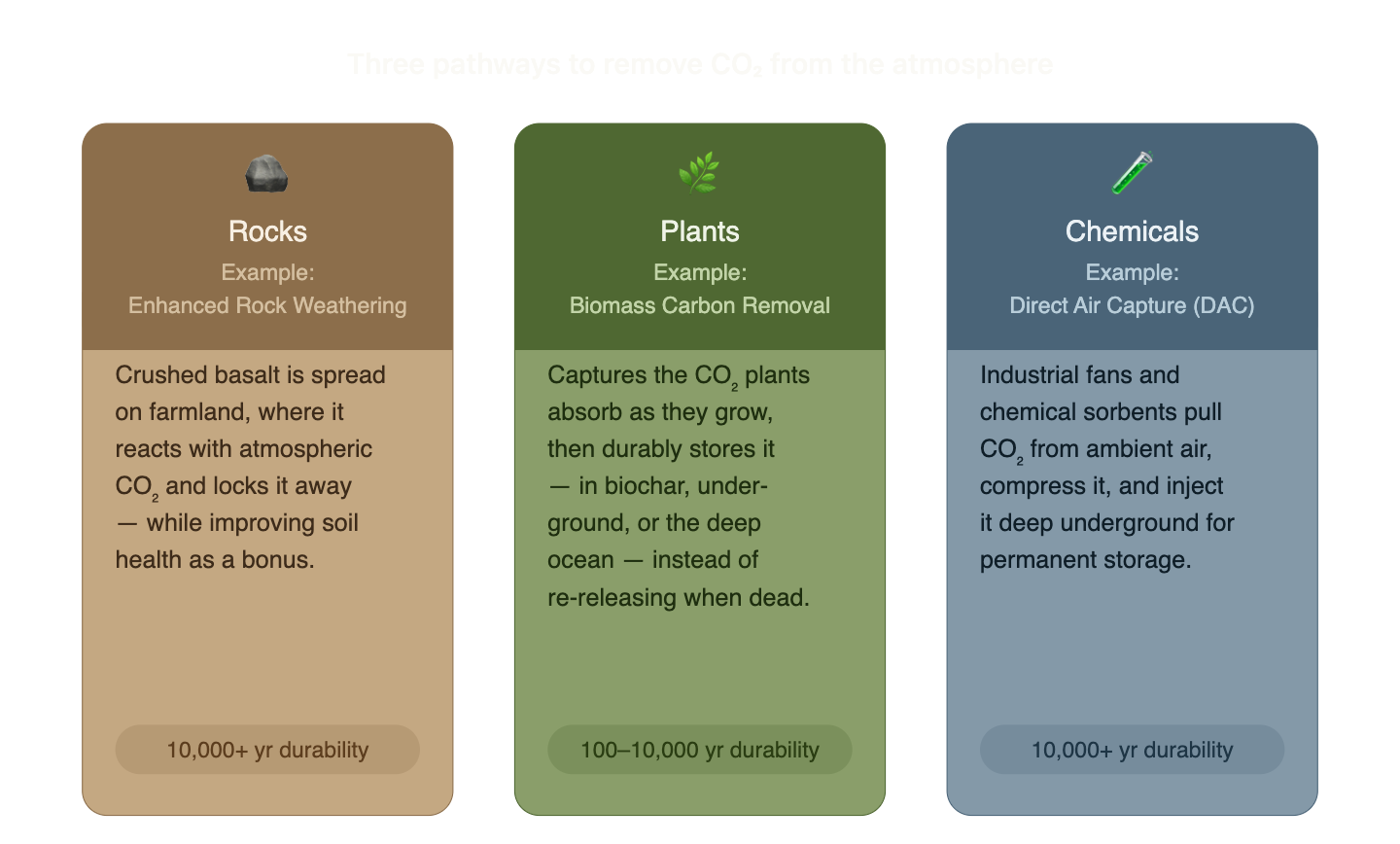
Caption: Rocks, plants, and chemical comprise the three modalities of CDR, with varying pathways and durabilities.
There are real projects running right now. Climeworks' Mammoth DAC plant in Iceland is already operational. Charm Industrial is converting agricultural waste into bio-oil and pumping it underground. Ebb Carbon is treating coastal seawater to enhance the ocean's natural carbon absorption
The science-based case for CDR
Here's the part that has me scratching my head. The Intergovernmental Panel on Climate Change (IPCC) has modeled hundreds of scenarios for limiting global warming to 2°C—the threshold scientists widely treat as the boundary between manageable and dangerous. Every one of those pathways includes significant carbon dioxide removal (IPCC, 2022).
Not just most of them. Every single one.
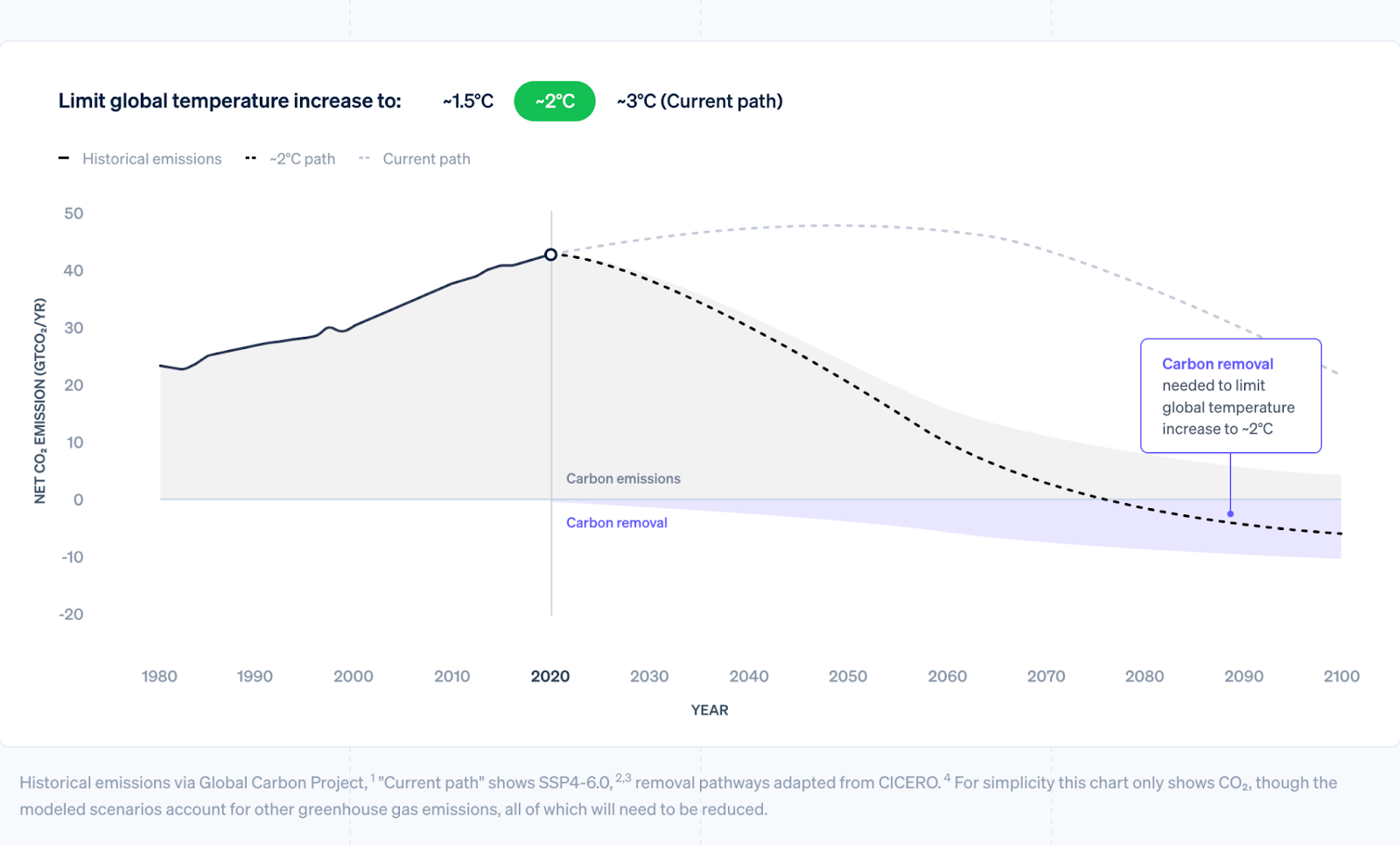
Source: https://stripe.com/climate
The scale required is staggering. By 2050, the IPCC's 2°C pathways require roughly 10 gigatons of carbon removal per year—equal to the current combined annual emissions of the United States and EU (IPCC, 2022).
We are nowhere close. As of today, engineered CDR has reached just 0.46% of that target (CDR.fyi, 2026). Less than half a percent.

Source: https://www.cdr.fyi/
Julio Friedmann, Chief Scientist at Carbon Direct, put the gap in plain terms: hitting 10 gigatons would require roughly 30 companies the size of Shell operating in this space. "That is a big market," he said. "That is the biggest market in all of human history" (Allsup, 2023). And we're treating it like a footnote.
But hang on a second. I can hear your question coming.
Doesn't this let polluters off the hook?
It's the right question. The moral hazard concern goes like this: if we can just suck carbon out of the air later, why bother cutting emissions now? Won't fossil fuel companies use CDR as cover to keep burning?
It's a legitimate concern, but it collapses the moment you understand the actual pathway. CDR isn't a replacement for decarbonization. It's the third step of a three-step drawdown sequence:
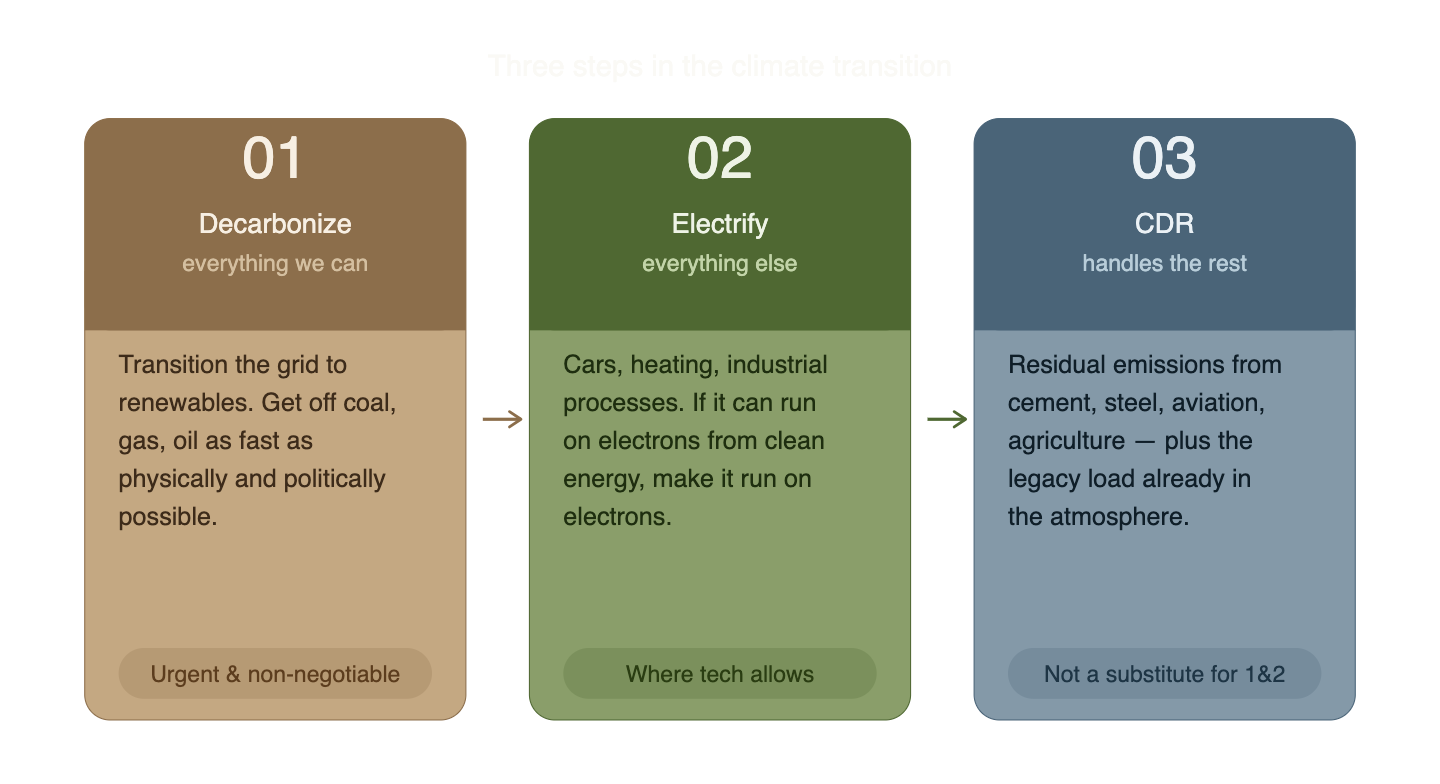
The three steps to get to net-zero include decarbonizing, electrifying, and using CDR for hard-to-decarbonize industries and historical emissions.
CDR isn't a hall pass. It's the part of the solution that handles what emissions reductions alone cannot.
Here's why: we don't actually know how to get to zero emissions. Modern life runs on things we can't easily decarbonize—medicines, roads, fertilizers that feed billions of people. So the realistic goal isn’t zero. It's net-zero. Reduce aggressively: clean the grid, electrify everything possible. But that still leaves a lot of thorny industries with nowhere to go. For those: CDR.
The real reason this matters right now
Here's the thing: we don't need CDR at full scale today. We need it at full scale around 2040 to 2050, when global emissions have (hopefully) been slashed and we're left managing the stubborn residual problem.
But we need to be building it right now.
Think about solar. In 2010, utility-scale solar cost over $350 per megawatt-hour. Today it's under $30. That’s a 90%+ cost decline driven by decades of early investment, policy support, and doing the work (IRENA, 2023).
CDR is at an early solar moment. Current DAC costs run $400–$1,000 per ton. Models suggest we need to get below $100—possibly much lower—to deploy at climate-relevant scale (Carbon Removal Alliance, 2026). That cost curve bends because companies take risks, engineers iterate, projects get built, buyers show up, and governments create policy frameworks that make the math work.
But building CDR can't come at the expense of decarbonization. Investment in CDR has to run alongside decarbonization. Clean energy resources shouldn't be diverted to power DAC plants when they're still needed to displace fossil fuels. The goal is parallel development: get the emissions down while building the removal infrastructure, so that when we've done everything the grid and electrification can do, the tools to handle the rest are actually ready.
What happens today determines what's possible in 2040. The research, the infrastructure, the workforce, the regulatory frameworks—all of it has to be built before we need it, or it won't exist when we do.
I spent a semester in a graduate CDR policy course, taught by practitioners who work in this space daily. I still walk out of every class struck by the same thing: this is essential, scientifically undeniable, actively being worked on by serious people, and almost completely absent from the public conversation about climate. It’s the missing puzzle piece.
The bathtub is full. We're finally getting serious about the faucet. It's time to do something about the drain.
Sources
Allsup, M. (2023, October 27). The carbon removal industry is in the 'figuring it out' phase. Latitude Media.https://www.latitudemedia.com/news/carbon-removal-progress-2023/
Carbon Removal Alliance. (2026). MENV 6100-002: Carbon dioxide removal [Course slides]. University of Colorado Boulder.
CDR.fyi. (2026). 10 gigatonne goal: Progress to 2050.https://www.cdr.fyi
IPCC. (2021). Climate change 2021: The physical science basis. Contribution of Working Group I to the Sixth Assessment Report of the Intergovernmental Panel on Climate Change (V. Masson-Delmotte et al., Eds.). Cambridge University Press.
IPCC. (2022). Climate change 2022: Mitigation of climate change. Contribution of Working Group III to the Sixth Assessment Report of the Intergovernmental Panel on Climate Change (P. R. Shukla et al., Eds.). Cambridge University Press.https://doi.org/10.1017/9781009157926
IRENA. (2023). Renewable power generation costs in 2022. International Renewable Energy Agency.https://www.irena.org/Publications/2023/Aug/Renewable-Power-Generation-Costs-in-2022
Stripe Climate. (n.d.). The climate math [Infographic]. Stripe.https://stripe.com/climate